Sprint planning for small teams when agents ship in hours
Sprint planning for small teams stops fitting once an agent finishes a card in hours. Keep a live board, a cap on review, and the decision that is blocking the work.
A two-week sprint plan is a bad fit once an agent finishes a card in a few hours. Sprint planning for small teams still has a job. The job is a live board people and agents pull from, a cap on what is waiting for review, and the decision that is actually blocking the work. The planning meeting is the part I would drop.
The question on r/jira
Imagine writing a complete user story, pasting it into Claude, and having a working feature a few hours later.
Do we still need to spend hours in sprint planning, breaking stories into tasks, estimating story points, and planning two-week sprints?
Honestly, I feel traditional sprint planning is becoming overkill for many small teams.
Tools like Jira still make sense for large enterprises with complex dependencies. But for a team of 2–5 people building a SaaS product, do we really need all that process?
We're moving towards milestone-based development, where the focus is more on outcomes than on managing tasks.
My take: AI isn't just changing how we write code. It's changing how we should manage software development.
What do you think? Are sprint planning and Jira still relevant for small teams, or are we holding on to outdated workflows?
u/nishantgohel:
"Are sprint planning and Jira still relevant for small teams, or are we holding on to outdated workflows?"
The post before that line is the version I see. You write a story, an agent has a working change a few hours later, and the planning meeting is still booked to break that story into tasks and estimate points. For a team of a few people, that meeting is overhead.
u/zaibuf:
"We've been doing Kanban for years. Scrum is just meeting hell. We still do refinements though, just no planning, points or sprints. What matters is having a shared understanding of scope, being able to ask questions and break down work into smaller pieces."
Yup. On scrum vs kanban for a small team, that is the split I use. I still want the shared understanding, and I still want a refinement when a card is unclear. I don't want the planning meeting, the points, or the sprint boundary.
Do we need sprints? When a client date is fixed, or the group is too big to share one board, yes. When the cards come back the same day, the sprint is a calendar event sitting on top of a queue.
The blocker is the decision
u/pineapplepredator:
"Yes. This is why project management can only help so much. The real blocker is the decision."
A card can look ready for an agent and still be waiting on a refund window, an API shape, or which client the change is for. The agent will guess if you hand it over. I would rather the guess never starts.
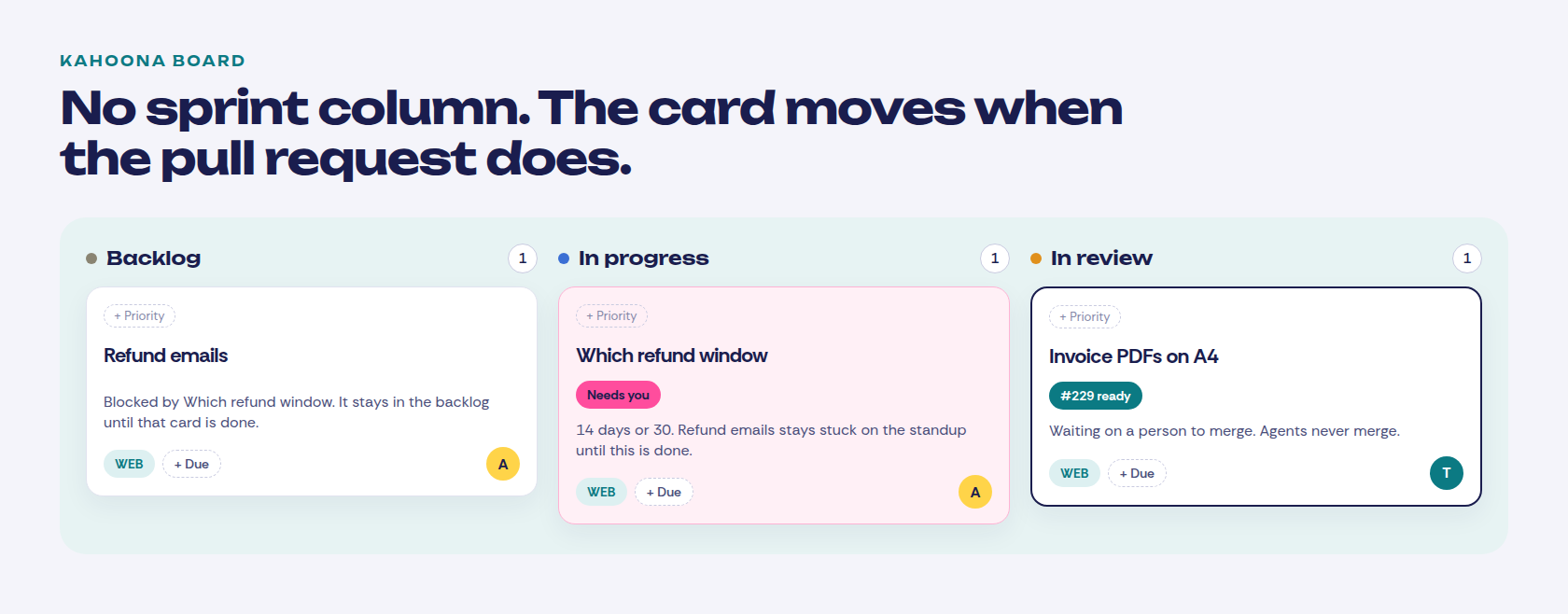
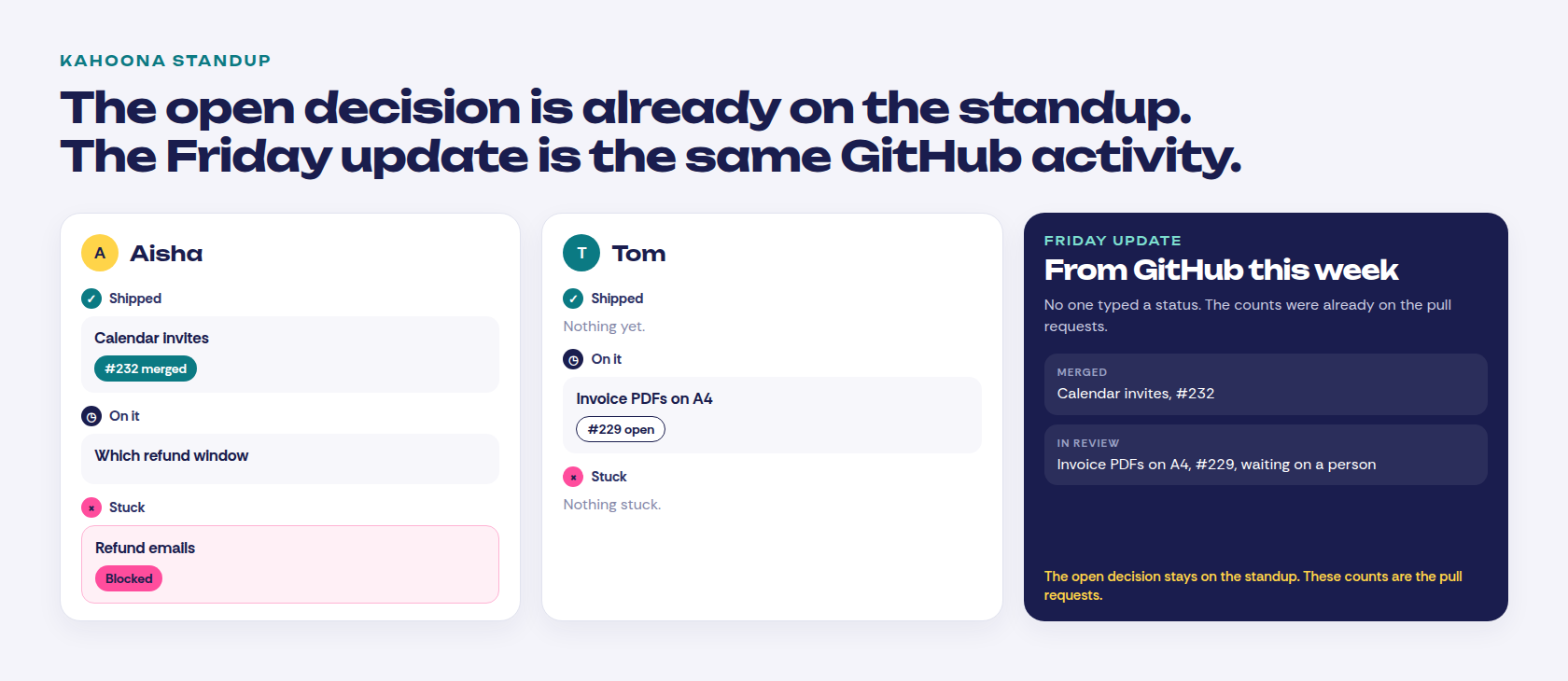
I put that decision on its own card and mark it as the blocker. On Kahoona a blocker is another card in the same project. If it is not done, the standup marks the blocked card stuck, on the person who owns it, with a Blocked chip.
Where a sprint still earns its keep
A sprint is the right tool when the date is the constraint. A client was promised something on a day, so a time box is honest. It is also the right tool when the org is large and the people who need to align are not looking at the same board. A checkpoint on a calendar is how that group meets.
I would keep the sprint there. I would drop the two-week planning meeting for a small team whose cards finish in an afternoon.
Jira is a reasonable home for that bigger org. I compared the boards in Kahoona vs Jira. If the company already lives in Jira and the sprint is doing the alignment job, keep it.
A pull board, a review cap, one decision card
The board is the queue. The next card is the top of the backlog, and it has an owner before an agent starts. You don't fill a sprint and then wait for the boundary to open. Who owns the next card is the longer version in A Claude Code kanban board: who owns the next task?.
Review is the column that fills up. If the team reads three pull requests on a normal day, the fourth card waits in the backlog. Handing agents more cards than that just moves the wait from planning to review. How I sort that queue is in How to review AI agent pull requests without drowning.
The decision stays a card, linked as a blocker, until someone finishes it. That is the whole replacement for the planning meeting. A shared queue, a cap on review, and the open decision where the team can see it.
How I run that on Kahoona
I built Kahoona, so weigh this part with that in mind.
You hand an agent a card by assigning it to Agent, or by writing @agent in a comment. It reads the card and comes back as a GitHub pull request. Your team reviews it and merges it. Agents never merge, and they never deploy. A project runs one of those cards at a time. The next one waits on the board as Next up.
The columns I use are Backlog, In progress, In review and Done. GitHub moves the card. A ready pull request lands in In review. A merged pull request lands in Done. If the checks still fail after 2 fixes, the pull request stays a draft and the card says Needs you.
The software template still has a Sprint field. It is a text label on the card. The board stays a pull queue either way.
The standup is grouped by the person who owns the card. Shipped includes a merged pull request. Stuck includes an unfinished blocker, so the open decision shows up on the owner without a status ping. The Friday update is the weekly digest on the GitHub tab. The counts are already there, from the repo. The paragraph is written the first time you open that week, from the GitHub activity already on the page.
Founders in
2020: We need a team of 10.
2023: A team of 5 and some AI.
2025: Me and a few agents.
2026: Agents, run the standup.
2027: ????
"2026: Agents, run the standup."
I want the standup to already be filled in, so nobody runs one for the agents. Several Claude Code or Cursor sessions are a separate problem. They are still your sessions, and Kahoona does not read those terminals. How I keep their questions on one board is in How to manage multiple Claude Code sessions without watching them.
Clients stay off the live board. A client page is a snapshot of what you chose to publish. Draft pull requests and the open decisions stay with the team. A client reply lands in the Client Inbox and does not change the card.
Kahoona is free for one person. On a team the first chair stays free and each extra chair is $5 a month, so five people pay $20 and ten pay $45. No card needed.
Kahoona does not type a WIP number onto the review column. That cap is still yours. It also does not pick the client date. If the date is the real constraint, plan to the date.
I build it, so this is the loop I use on my own board, and a person still merges.