Claude Code to Jira won't fix your process
Claude Code to Jira reads the ticket faster. The sprint, the review queue, and a hand-updated board stay built for humans typing the code.
Connecting Claude Code to Jira won't fix your process. The agent reads the ticket faster. The tracker, the sprint you already committed, and the review queue are still built for a person typing the code.
The ticket is still the work
Thoughts after talking to lots of engineers in London in last couple of days:
• Everyone's moving into the same direction and getting more and more agent-pilled, but all on individual speed. No group of engineers right now is uniformly agent-pilled.
• Becoming agent-pilled is a one-way door. You only realize this once you've gone through. Many think they "get it" but haven't made the switch yet.
• Wild how many orgs are still treating agents as "thing that writes code on my computer" instead of robot-engineer that can help with whole SLDC.
• Teams are drowning in PRs and code review. No process has been changed yet, even though this is the biggest dev productivity lever of last 30 years, engs still work off tickets like nothing happened. Wild.
• Barely anyone realized yet that, hey, even if the model isn't good enough to write the code the way you'd write it [doubt it], they can surely write all of the peripheral tooling to speed you up.
• Very few engineers have imagination to come up with better tool. Instead of reviewing code in diffs, line by line, think: if I could wave a magic wand and make tooling disappear, what tooling would I want to gain confidence in this change being correct? Full instrumented/traced end-to-end runthrough? Demo videos? In-production probes? High-fidelity and anonymized production data fed through test runs? New testing environments with the greatest debugging MCP support one can imagine so agent can inspect everything?
It's time to dream big.
But seems like most people's dreams don't reach further than "this agent works off the tickets assigned to me 10x faster than I can."
Thorsten Ball posted that on November 18, after talking to engineers in London.
Teams are drowning in PRs and code review. No process has been changed yet, even though this is the biggest dev productivity lever of last 30 years, engs still work off tickets like nothing happened. Wild.
Yup. The pull request pile is the work. The ticket is still the plan. Claude Code, Codex, Kimi, Opus, they will write the change. The ticket they were pointed at was still written for a person who was going to type it.
Wild how many orgs are still treating agents as "thing that writes code on my computer" instead of robot-engineer that can help with whole SLDC.
SLDC is his spelling. The computer version is the one I actually run. It writes code. It does not change the queue the ticket sits in.
It's time to dream big.
But seems like most people's dreams don't reach further than "this agent works off the tickets assigned to me 10x faster than I can."
Yup. The 10x ticket is a small dream. I would not start by dreaming up tooling. The board has to stop pretending the ticket is the work. A faster reader of the same ticket is the same process, with a shorter wait before the pull request.
The review pile is a different post. How I keep that queue from becoming the job is in How to review AI agent pull requests without drowning. I am not repeating it.
Connecting Claude Code to Jira is still the ticket
@thorstenball In Slack, today:
"Have you guys tried connecting Claude Code to Jira?"
Andrei Maxim posted that the same day, as a reply. He is quoting someone in his Slack. He is not asking the question himself.
In Slack, today: "Have you guys tried connecting Claude Code to Jira?"
That question is the bolt-on. Connect Claude Code to Jira, the agent picks up the ticket, the ticket was still written for a person. Jira for AI agents can mean that wire. The wire is not the workflow.
The problem aint the connection. Jira can be connected to agents. I am not saying the integration is impossible. Whether you stay, or you want a Jira alternative built around the agent loop, is Kahoona vs Jira. I am not restating their prices here.
What did not move is the ticket workflow. A sprint still commits a list. A person still updates the card when they remember. The review queue still assumes the diff was typed by whoever the ticket was assigned to.
The card has to be a spec
When the code is cheap, the card is the job. A ticket that says "add dark mode" has no edges. What done looks like, and what this card will not do, goes at the top of the description before you assign it. Keeping that plan cheap to change is A living project plan beats a perfect one. Putting the decision where the next session can see it, instead of the middle of a markdown file, is A markdown backlog for AI coding agents.
Claude Code, Cursor, Codex CLI, Claude Desktop, and VS Code can read that card over MCP. get_task returns the description. Those sessions open the pull request on their own computer. If the pull request names the card, the board moves it. The install is in Let Claude Code and Codex pick up tickets from your board with MCP. Connecting an agent to a tracker is not the same as handing it a spec.
Yes Debt gets worse when typing is cheap
A pattern I keep seeing in stand-ups and planning: a request comes in late (real-time sync, dark mode and "a small AI feature" by Friday), there's a pause, and someone says "yes." No trade-off, no re-plan. The ticket goes into the sprint, and the sprint is now quietly 140% committed.
I've started calling it Yes Debt. Every yes with no conditions borrows capacity from future sprints. You pay it back in carry-over, rushed testing or a 2 a.m. incident. Velocity looks fine until it doesn't.
Some of the yeses I recognise:
- The Optimist: "like, two days." It is never two days.
- The Hostage: the yes that really means "please, somebody, help."
- The Thumbs-Up: a single 👍 on a 900-word spec.
I think the ceremonies make this worse when people feel that "no" is risky: layoff anxiety, demos that make big work look quick, and video calls with nobody's camera on.
Two things that seem to help:
- A priced yes: "Yes, by Friday, if we drop dark mode." The trade-off goes back to the PO, where it belongs.
- When someone agrees too fast, ask: "What would we have to say no to?"
How do your teams surface trade-offs before planning practices that make "no" safe to say?
u/Crafty_Respect4928 posted that on November 18. They call the pattern Yes Debt.
Every yes with no conditions borrows capacity from future sprints.
A priced yes: "Yes, by Friday, if we drop dark mode." The trade-off goes back to the PO, where it belongs.
Yup. That was already true when a person typed the code. It is worse once the typing is cheap. Capacity is review time and decision time. It is not keystrokes. Every yes with no conditions borrows the review queue, and the next decision, from whatever you already said yes to.
On r/ClaudeCode, u/h7hh77 wrote:
Productivity has risen but requirements did as well, so I gained nothing from said rise in productivity.
Yup. The gain got eaten. More requirements, same week. I would price the yes. Drop something, or do not hand the card to the agent.
A two-week planning meeting on top of cards that come back in hours is the other half. That writeup is Sprint planning for small teams when agents ship in hours.
Kahoona will not stop the yes for you. The software template has an Effort field, XS through XL, and an Estimate field in points. Sprint is a text label. Nothing reads those fields and replans the board. Nothing blocks a card because the week is already full. If you want a tool that refuses scope, this is the wrong one.
The board has to move from the pull request
A person updating the ticket after the pull request opened is the old loop with a faster typist. The board should move when the pull request does.
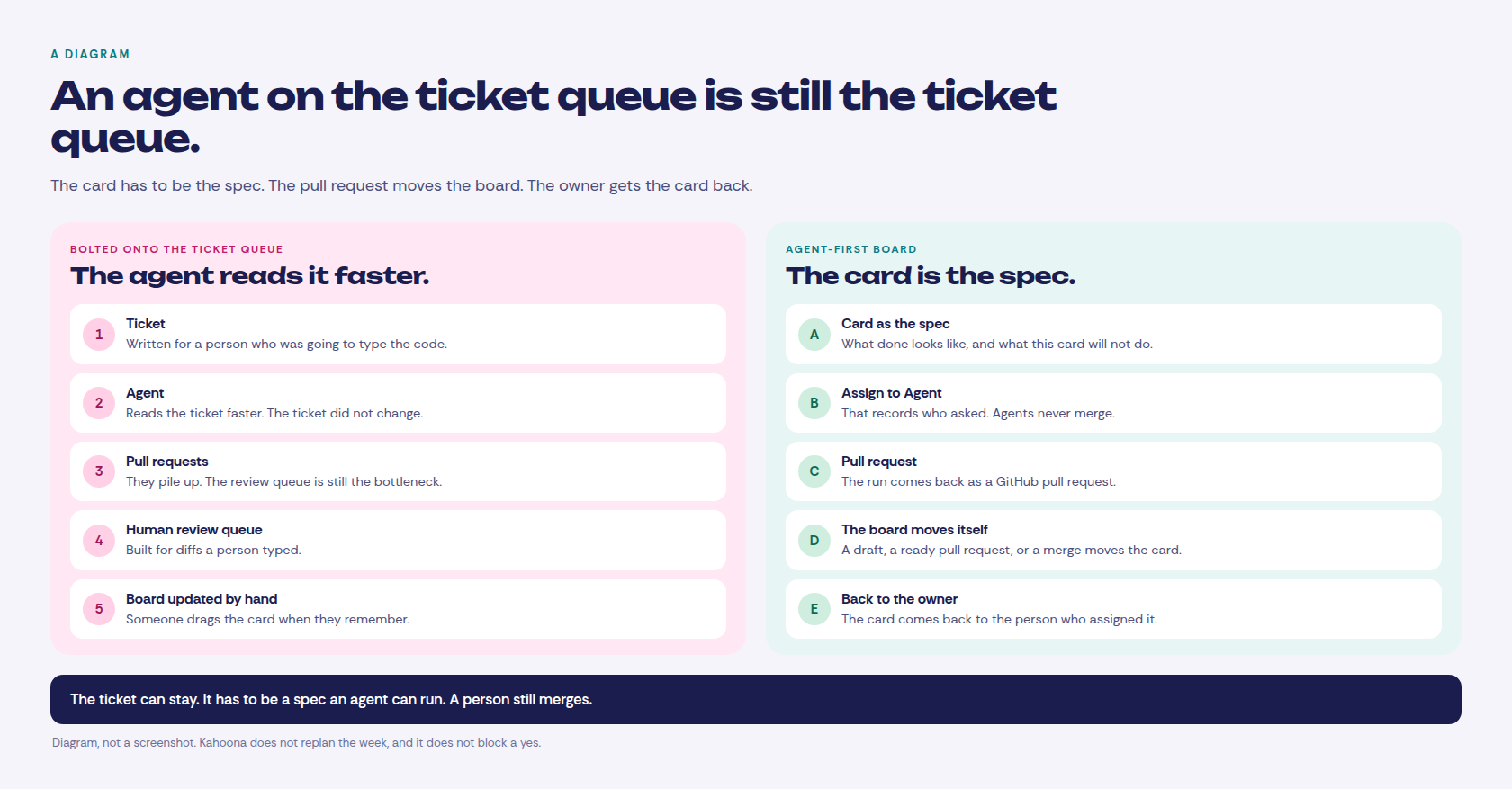
On Kahoona, GitHub moves the card when a pull request names it and the sender is not a bot. A draft opening moves it to In progress. A pull request that opens ready for review, or a draft marked ready, moves it to In review. A merge with a closing word, on the branch the project watches, moves it to Done. Closing a pull request without merging only suggests a move back. The card does not walk backwards on its own. The longer version of the plan on the card, before anyone builds, is the living plan post. I am not repeating it.
The standup and the Friday update are the short version of that same loop. The standup is the board. The Friday note is the week's GitHub activity on the project. Both are already written up in Replace the daily standup with what shipped.
A person still owns every agent card. You assign the card to Agent, and that records who asked. The run comes back as a GitHub pull request. Agents never merge. When the run stops, the card goes back to the person who assigned it. Who that person is, before anyone starts, is in Name a human owner before the agents open pull requests.
What I run, and what it will not do
I built Kahoona, so weigh this part.
You assign the card to Agent, or you write @agent. Assigning it records you. A mention leaves the card with whoever already owns it. The run comes back as a GitHub pull request on the repo linked to the project. Agents never merge, and they never deploy.
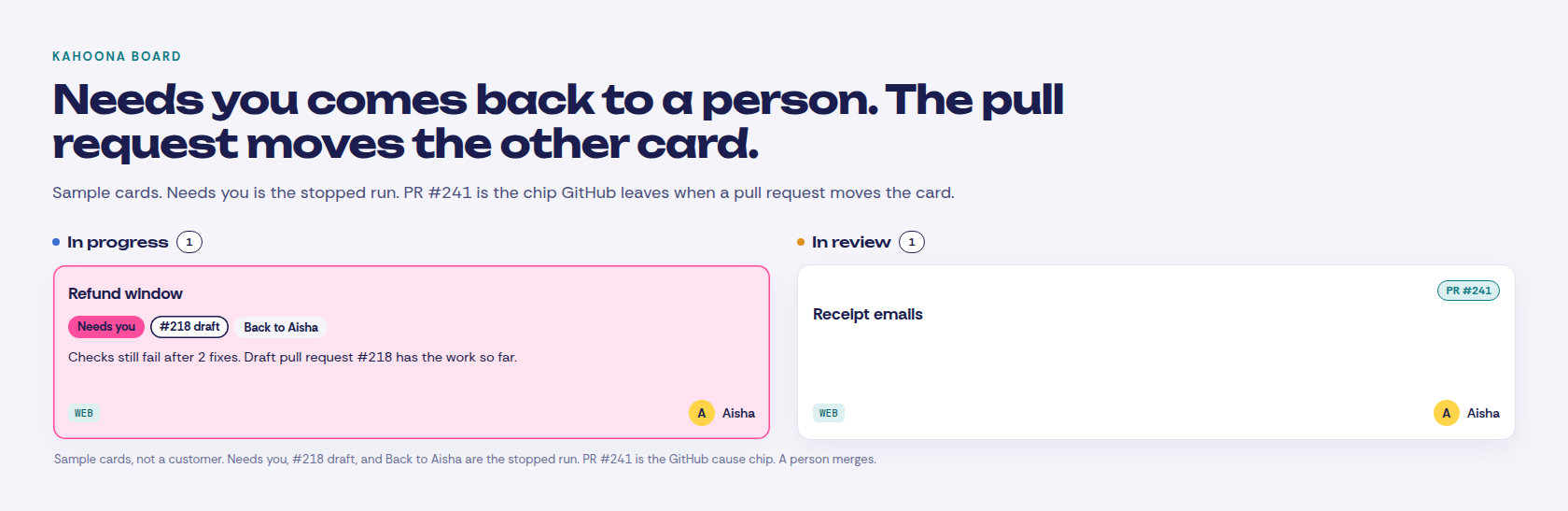
If the checks still fail after 2 fixes, the pull request stays a draft, the card says Needs you, and it sits in In progress, handed back to the person who assigned it. The line on the card says the checks still fail after 2 fixes, and it names the draft. A question on the card says Question for you. Needs you is the stopped run. If that person has left the workspace, the card is unassigned. A card someone already gave to another person is left alone.
A pull request from Claude Code, or from anyone else who is not a bot, moves the card it names. The card shows the pull request number. You did not drag it.
Kahoona does not import Jira, and it does not sync a Jira board. It does not post to Slack. It does not replan capacity, and it does not block scope creep. The yes is still yours.
If the company already lives in Jira, stay there. Kahoona vs Jira. A Jira site can already be connected to an agent. If that connection is enough, and the rest of the company is in Jira, I would not move them for a board.
Kahoona is free for one person. On a team the first chair stays free and each extra chair is $5 a month, so five people pay $20 and ten pay $45. It is a web app.
Put the spec on the card before you assign it. Let the pull request move the board. A person still merges.