Replace the daily standup with what shipped
Replace daily standup status talk by reading what shipped, what is on it, and what is stuck. Meet only on the stuck items and the decisions a person still has to make.
You can replace the daily standup. Drop the round where everyone reads yesterday out loud. Read what shipped, what is on it, and what is stuck before anyone talks. If you still meet, the status meeting is the stuck items and the decisions waiting on a person.
The code only covers what landed
The best thing I've done as a CEO this year is connect an LLM to every engineer's GitHub repo. I read what actually shipped, in plain English, mapped to the business goals I care about, before I talk to anyone. No daily standup, no hour-long status meeting twice a week. When we do meet, I show up already informed and ask three sharp questions instead of thirty lazy ones. Engineers get their time back and I get a clearer picture than any meeting ever gave me. The code is the status update now. It's a fun time to build.
KF posted that on November 17. The account is writing as a CEO. The company is not named. This is their report of their own week. I am not treating it as data.
The best thing I've done as a CEO this year is connect an LLM to every engineer's GitHub repo. I read what actually shipped, in plain English, mapped to the business goals I care about, before I talk to anyone.
Yup on the order. Read what actually shipped, in plain English, before you talk to anyone. The problem aint the meeting. It is spending the meeting on status the board already has.
No daily standup, no hour-long status meeting twice a week. When we do meet, I show up already informed and ask three sharp questions instead of thirty lazy ones.
Showing up informed is the point of dropping the status round. The three questions are their meeting. I did not measure them. The lines about engineers getting their time back, and a clearer picture than any meeting, are how it felt to them. I don't have their repos.
The code is the status update now.
That sentence covers what landed. Code does not tell you what is stuck, which card is waiting on a person's decision, what has no pull request yet, or who owns it. A quiet repo can mean the work shipped. It can also mean the card is blocked and nobody opened anything. I want the list before the questions.
Kahoona does not connect a model to every engineer's repo, and it does not map the work to the business goals you care about. If that mapping is the job, this is the wrong tool for it.
A daily standup with AI agents is still a meeting
Joke aside: Why should we still hold meetings in the age of AI agents? My take: within a year, we will replace human meetings with team meetings involving AI agents.
Just as my own "Grokbots" already hold team meetings twice a day, which I simply attend mostly as an observer.
Chubby posted that on November 16.
Joke aside: Why should we still hold meetings in the age of AI agents? My take: within a year, we will replace human meetings with team meetings involving AI agents.
Just as my own "Grokbots" already hold team meetings twice a day, which I simply attend mostly as an observer.
I don't think this is true. An agent does not need a meeting. Its status is the card and the pull request. A person still owns each card and decides. Being an observer of your own team is the wrong role. You are there to unblock the stuck card, or you are not in the room.
A daily standup with AI agents adds chairs. It does not add the decision. Claude Code, Cursor, Codex, and Kahoona's own agent already leave a status when the card moves. Reading that status back in a circle is the round-robin again.
Replace daily standup status, then talk about stuck
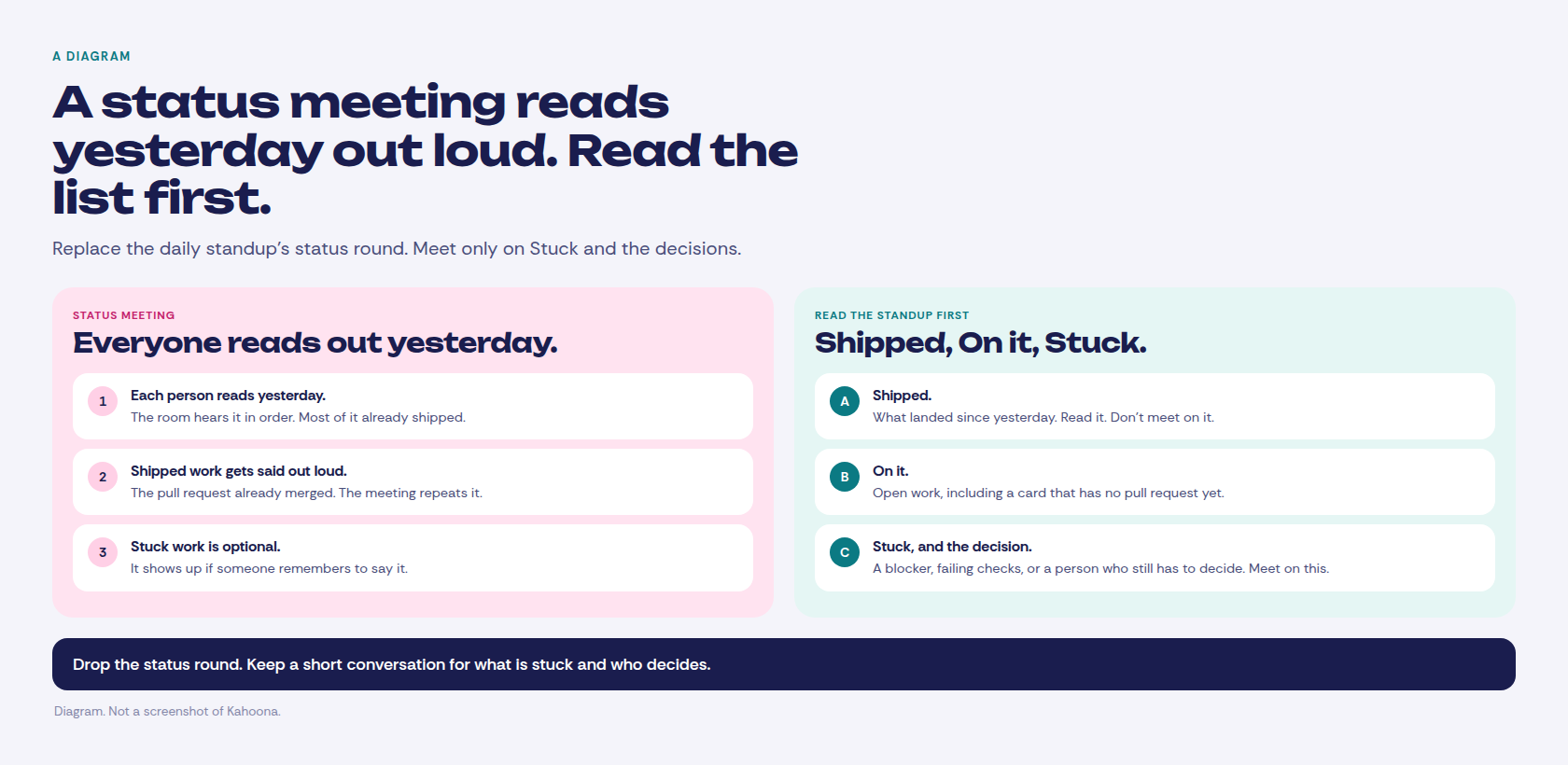
The status round goes. The stuck list stays, because a reading of what shipped will not surface it. On it can be a card in progress with no pull request yet. Stuck is a blocker, failing checks, or a card waiting on a client. The decision is a person. The code never named them.
An async standup is that list. Standup meeting alternatives that replay "what did you do" for an hour are the same meeting with a calendar invite. I would not add one.
The note itself, bottom line first, is in A status update template for agents: BLUF, then SBAR. I am not repeating the template, and I am not repeating how the standup paragraph is written. Shipped on the list is not a score. That argument is in Stop counting pull requests now that agents open them. Who answers for the date when they did not do the work is in Project manager accountability when you don't do the work. The plan on the card, before anyone builds, is in A living project plan beats a perfect one. What the agent should ask a person, instead of deciding it, is in What coding agents should decide, and what they should ask you.
What I actually open
I built Kahoona, so weigh this part.
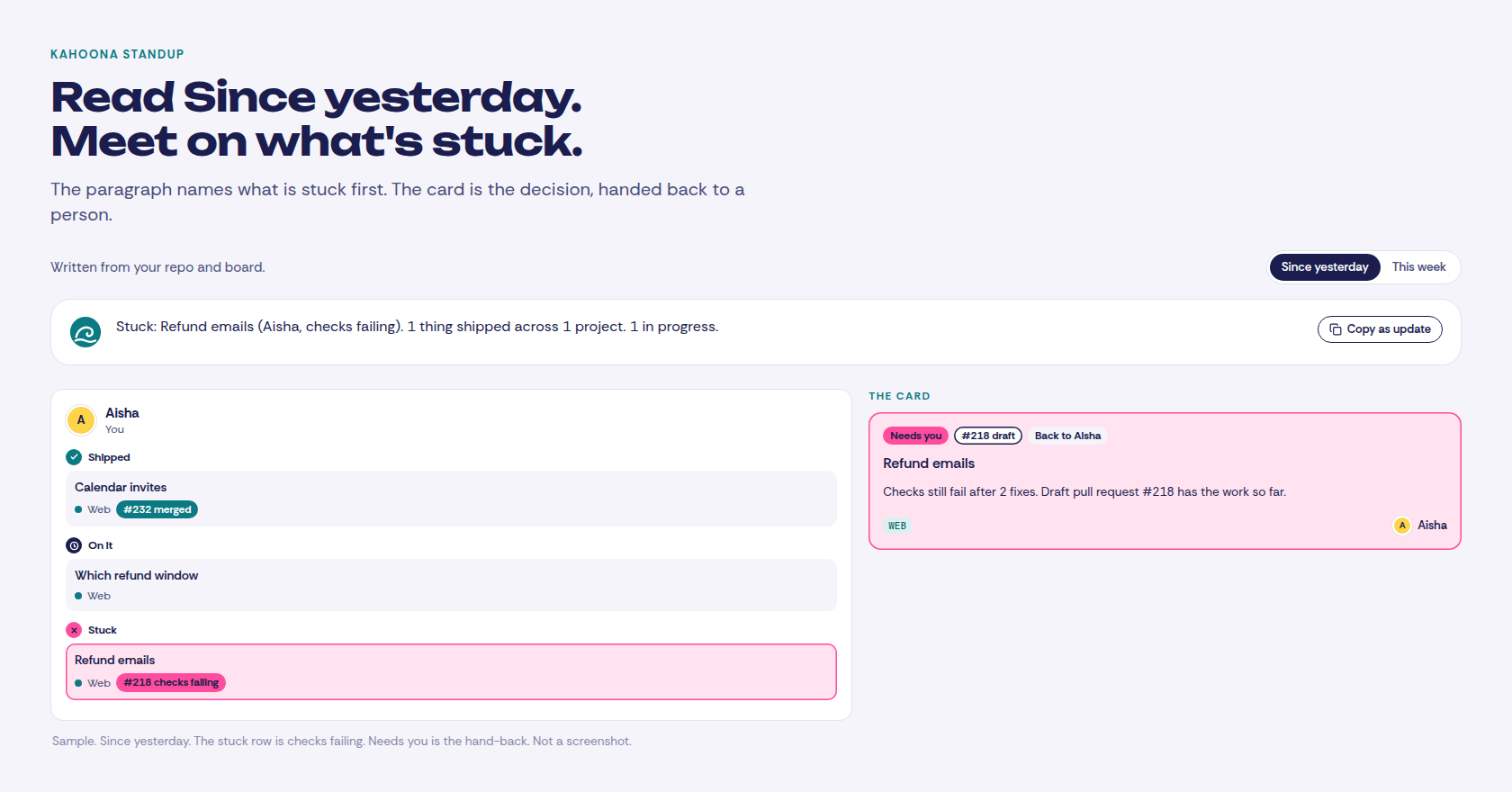
The standup groups the board by the person who owns the card. The switch says Since yesterday and This week. Since yesterday is the previous working day, so Monday and the weekend look back to Friday. This week starts on Monday, in your timezone. The line under the switch says "Written from your repo and board."
Shipped is a card in a complete column in that window, under the assignee. A linked pull request that updated to merged in the window can mark the time. On it is a card in a working column, under an assignee. On the default board that is In progress or In review. A card can sit there with no pull request. A card still in Backlog is not On it, unless it is stuck. A card with nobody on it does not show as Shipped or On it. If it is stuck, it shows under Unassigned.
Stuck is an unfinished blocker, failing checks on an open or draft pull request from the last week, or a client approval that is still pending or has changes requested. The chips say Blocked, #N checks failing, or Waiting on client. Waiting on client is not the Needs you chip.
A paragraph sits above the wall. It is written when you open the standup, if none is cached or the cached one is older than an hour. It names what is stuck first. If the model is not available, or the call errors, the paragraph is the plain counts from the same data, still stuck first. Private projects are left out of that shared paragraph. Copy as update copies the paragraph. It does not write the decision for you.
A card still assigned to Agent does not get a standup column. The agent user is named Agent, and it is not a member. You assign the card to Agent, or you write @agent. Assigning it records who asked. A mention leaves the card with whoever already owns it. The run comes back as a GitHub pull request. Agents never merge. When an assigned run stops for a person, the card goes back to the person who assigned it. If the checks still fail after two fixes, the pull request stays a draft, the card says Needs you, and it names that draft. It also says Back to that person. If they have left the workspace, the card is unassigned. A question during the run says Question for you. That card can still be assigned to Agent, so it is not a column of its own. The decision is the person's card, not a meeting the agents hold.
The weekly timeline on the GitHub tab is what I use as the Friday update. It is that project's GitHub activity. The paragraph is written the first time you expand the week. It does not know a decision that exists only on the card.
GitHub can move the card when a pull request names it. A draft opening moves it to In progress. A pull request that opens ready for review, or a draft marked ready, moves it to In review. A merge with a closing word, on the branch the project watches, moves it to Done. The closing words and the exceptions are in the living plan post. I am not repeating them.
If the team already runs this in Jira, stay there. Kahoona vs Jira. If the board is already Linear, stay there. Kahoona vs Linear. If the work lives on Trello or ClickUp and most of it is not code, the comparison is Kahoona vs Trello vs ClickUp. I would not move a team off a board that already shows who is stuck, just to get this view.
Kahoona is the wrong tool when you want it to schedule the meeting, place a video call, or have agents meet each other. It does none of that. It does not read every engineer's repo, and it does not map the week to business goals. It does not post the standup to Slack. It does not track a decision you never wrote down. The list is the board you already keep. The decision is the card, or the sentence you put on it.
Kahoona is free for one person. On a team the first chair stays free and each extra chair is $5 a month, so five people pay $20 and ten pay $45. It is a web app.
Read the list. Talk about what is stuck. A person still decides.