Project manager accountability when you don't do the work
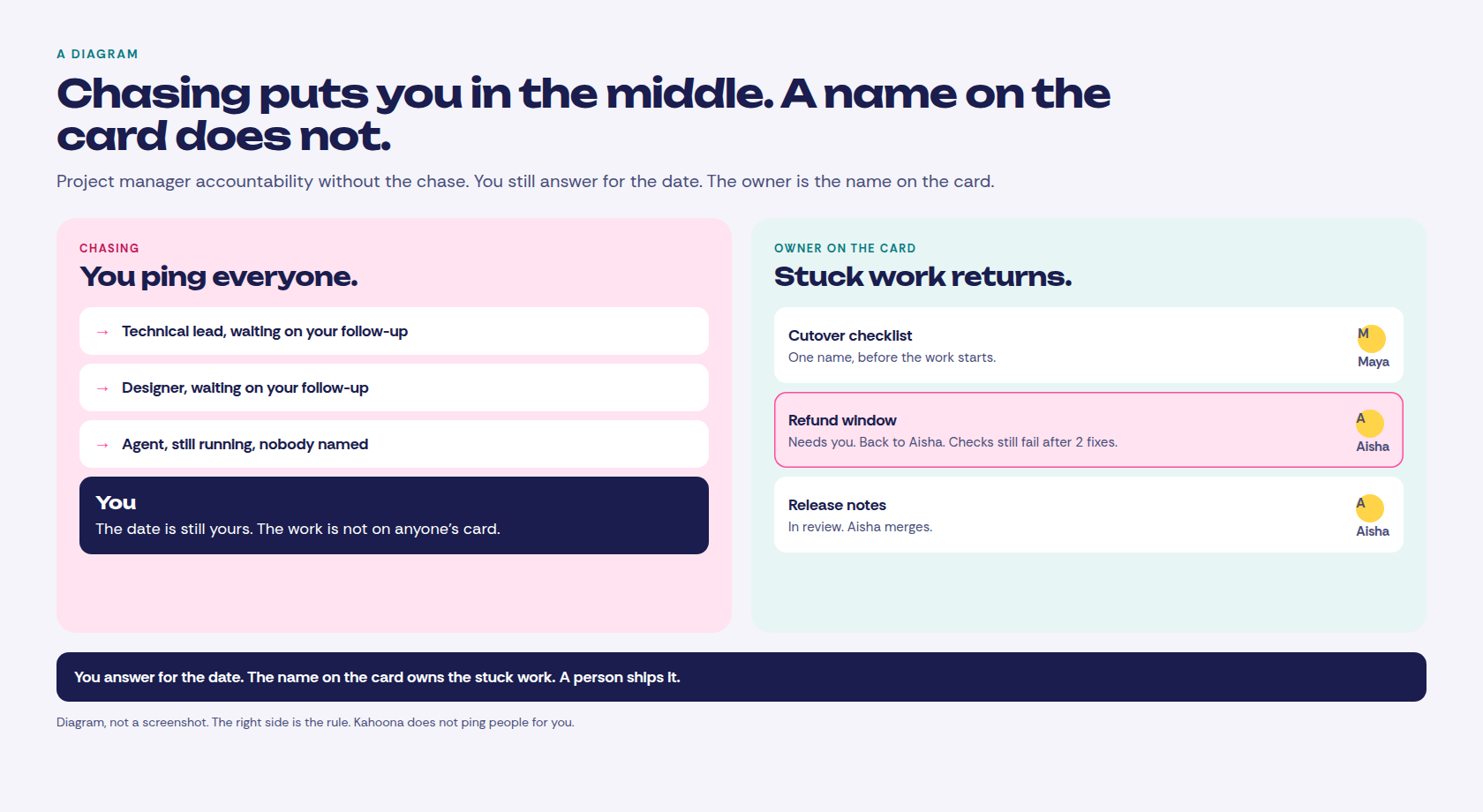
Project manager accountability is a name on the card. You answer for the date. Someone else does the work. Stuck work comes back to that person.
Project manager accountability is being the person who answers for the date when you did not do the work. Chasing every lead until they move does not scale. Put one name on the card. When the work sticks, it comes back to that name. A person approves before anything ships.
I have around 11 years of experience in IAM/cybersecurity, primarily in development, support and architecture. Last year, I transitioned into Project Management.
My role now involves governance, milestone tracking, resource management and stakeholder communication.
I’ve spent the last 4–5 months on a particularly challenging client project with constantly changing priorities, technical complexities and a team that struggles to meet commitments.
What I’m finding difficult is being accountable for delivery when the actual execution is in other people’s hands. Even when I’ve followed up, identified risks and escalated issues, I’m still the person answerable for missed milestones.
I’m also learning to manage people who were previously my peers, and getting them to take ownership rather than relying on me to chase everything has been challenging.
For experienced PMs:
Is this level of stress and accountability typical?
How do you stop taking ownership of things outside your control?
How do you make technical leads accountable without constantly chasing them?
Are internal PM roles less stressful than client-facing delivery roles?
Is this something that gets easier with experience?
I originally moved into management hoping for better work-life balance, but I’m beginning to question whether this career path is right for me.
Would appreciate some honest perspectives, particularly from people who transitioned from technical careers into PM.
u/thesnidezilla posted that on November 11. New to the PM seat, still the name on the missed milestone. The line I keep is this one.
What I’m finding difficult is being accountable for delivery when the actual execution is in other people’s hands.
And:
Even when I’ve followed up, identified risks and escalated issues, I’m still the person answerable for missed milestones.
Yup. The follow-up happened. The risk was named. The escalation went out. The date is still yours. The next line is the actual job.
getting them to take ownership rather than relying on me to chase everything has been challenging.
Then the question under it:
How do you make technical leads accountable without constantly chasing them?
Chasing is what you do when the card has no owner. How to hold your team accountable without micromanaging is smaller than a process doc. One name on the card, before the work starts. The decision and the question live on that card. If it sticks, it is still their card. You stay answerable for the date. You are not the person who has to ping the thread.
Project manager accountability without the chase
A recap is a bad owner. On how did you survive without AI, u/bbbbbbbssssy wrote:
Seems like it was much easier to pay attention to grab key points & questions then assign out real-time then to wade through the ramblings of ai recaps.
u/painterknittersimmer wrote: "Notes were taken on screen and responsibility was randomly assigned at the start of the meeting."
Assign it while everyone is still in the room. The name goes on the card. I do not have a recap that turns into tasks. The owner is whoever you named.
The same rule shows up once agents do some of the work.
You can build a coding agent loop in a weekend. Plan, edit, run the tests, fix, open a pull request. Plenty of teams have done it.
What takes months is everything around the loop that you'd need before letting it near a customer's codebase. This is the list we work to, and none of it is the agent itself:
1. Every model call goes through one gateway, with a spend cap on every key. A direct call to a model provider is treated as a bug.
2. Each task runs in a fresh sandbox with no credentials in it, and the sandbox is thrown away afterwards.
3. There's a hard limit on attempts and cost, so a stuck task goes back to the board instead of burning money.
4. Every line of code can be traced back through the session, commit, pull request and ticket to the epic.
5. A prompt change doesn't ship until a set of test cases passes.
6. A person approves every pull request before it merges.
So when a CTO asks me whether they should build their own, I usually ask how many of those six they already have.
If it's two, sure, build the loop. Just budget for the other four, because that's where the time goes.
Mark Ajzenstadt posted that on November 12. He founded Limestone, and he sells AI engineering services, so this is his working list, not a study. "You can build a coding agent loop in a weekend." The line I use is item 3. "There's a hard limit on attempts and cost, so a stuck task goes back to the board instead of burning money." And item 6. "A person approves every pull request before it merges."
That is the rule I want for people too. A cap, then the card comes back to a named person. A person ships it. An agent that runs until the money is gone is the same failure as a lead you keep chasing. The work sat there. Nobody owned the stuck state.
What the card has to show
I built Kahoona, so weigh this part.
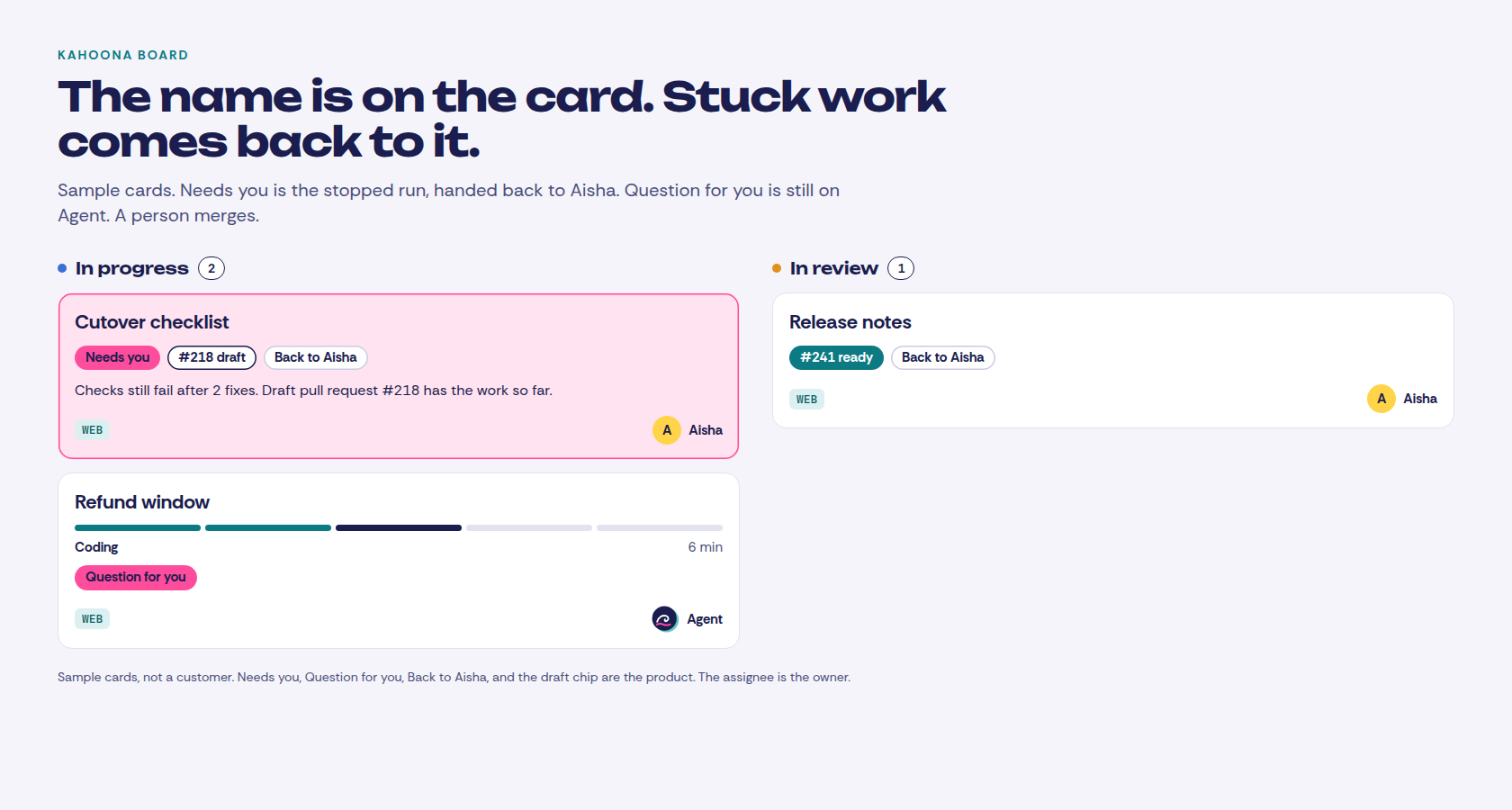
The name is the assignee. One person per card. The standup groups by that assignee, so a stuck card shows under their name. It does not ping them. There is no reminder, no due-date chase, and no per-person workload view. If you want a tool that nags the team for you, this is the wrong one.
For an agent, you assign the card to Agent. Agent is in the assignee picker. You can also write @agent in a comment. Assigning it records you as the person who asked. A mention leaves the card with whoever already owns it. The mention does not take the card.
When that assigned run succeeds, fails, or gets stuck and needs input, the card is reassigned to the person who assigned it. If they have left the workspace, the card is unassigned. A card someone already gave to another person is left alone. On a fail or a stuck run the card moves to the team's In progress column and says Needs you. On success it moves to In review.
The agent fixes failing checks up to twice. If they still fail, it opens a draft pull request and the card comes back. The comment says the checks still fail after 2 fixes, then names the draft that has the work so far. A run stops after 45 minutes. The line then is "The agent ran out of time (45 minutes). The card is back with you." The model bridge enforces a per-card spending limit, so a stuck run does not keep spending.
A question during the run shows Question for you on the card and lands in team notifications. The agent is told to ask, then carry on with its best assumption and say which one it made. A question does not pause the run. Needs you is the stopped run. You answer on the card. What the agent should decide alone, and what it should ask, is in What coding agents should decide, and what they should ask you. A status that is one line, then the handover, is in A status update template for agents: BLUF, then SBAR.
Agents never merge and never deploy. A person merges. Merging the pull request moves the card to Done when the title or body uses a closing word, such as Fixes WEB-14, and the merge lands on the branch the project watches. Who that person is, before the run starts, is in Name a human owner before the agents open pull requests. Several sessions on one board, without watching the spinners, is in How to manage multiple Claude Code sessions without watching them.
Write the decision in the description, at the top, so the next person and the next run see it. Put the question in the thread on the card. Do not keep either one in a side chat the card never shows.
When Kahoona is the wrong board
If the company already lives in Jira, stay there. That comparison is Kahoona vs Jira. If the questions are already visible in Linear, stay there, in Kahoona vs Linear. Trello is the right board when the work covers more than code. That comparison is Kahoona vs Trello. GitHub Projects is the right board when you want it inside GitHub and you do not want another product. That comparison is Kahoona vs GitHub Projects.
Kahoona is the wrong tool when you want it to chase people, send reminders, or show who is over capacity. It will not. It is also the wrong tool when you want the agent to merge.
Kahoona is free for one person. On a team the first chair stays free and each extra chair is $5 a month, so five people pay $20 and ten pay $45. The agent is not a member, so it is not an extra chair. It is a web app.
Put the name on the card. Stuck work comes back to that name. A person ships it.