AI coding policy for teams, written short
An AI coding policy for teams is a short page: which tools, what never goes in a prompt, a named owner, and a board that shows the work. A 30-page doc will not get read.
Write an AI coding policy for teams. Short. If the tools are already in use and nobody wrote down which accounts, you do not have a policy.
The tools are already in
All the engineering teams I talk to already use AI coding tools.
Very few non-enterprise teams have written down how.
One engineer tried Copilot. Another brought Cursor. Someone connected Claude Code to the repo.
Six months later, nobody can say which accounts are in use or what data has gone where.
From my perspective, the fix is not a 30-page document nobody reads. It's two or three pages that answer the questions engineers actually ask:
→ Which tools can I use?
→ What can I paste into them?
→ What do I have to check before I merge?
"the AI wrote it" is never an explanation for a bug. AI is a tool. The engineer is still the author.
How does your team handle it today?
Adhithi Ravichandran posted that on November 19.
All the engineering teams I talk to already use AI coding tools.
Very few non-enterprise teams have written down how.
One engineer tried Copilot. Another brought Cursor. Someone connected Claude Code to the repo.
Six months later, nobody can say which accounts are in use or what data has gone where.
Yup. Copilot here, Cursor there, Claude Code pointed at the repo. Six months later nobody can say which accounts are in use. This is her report from the teams she talks to. I am not treating it as a survey.
From my perspective, the fix is not a 30-page document nobody reads. It's two or three pages that answer the questions engineers actually ask:
Yup on skipping the 30-page doc. She wants those pages to say which tools, what you can paste, and what you check before you merge.
"the AI wrote it" is never an explanation for a bug. AI is a tool. The engineer is still the author.
Yup. The engineer is still the author. I would not write two or three pages either. An AI usage policy for software teams that nobody finishes is the same as no policy. And a page, even a short one, tells people the rules. It does not tell you what the agents are doing today.
An AI coding policy for teams is a short page
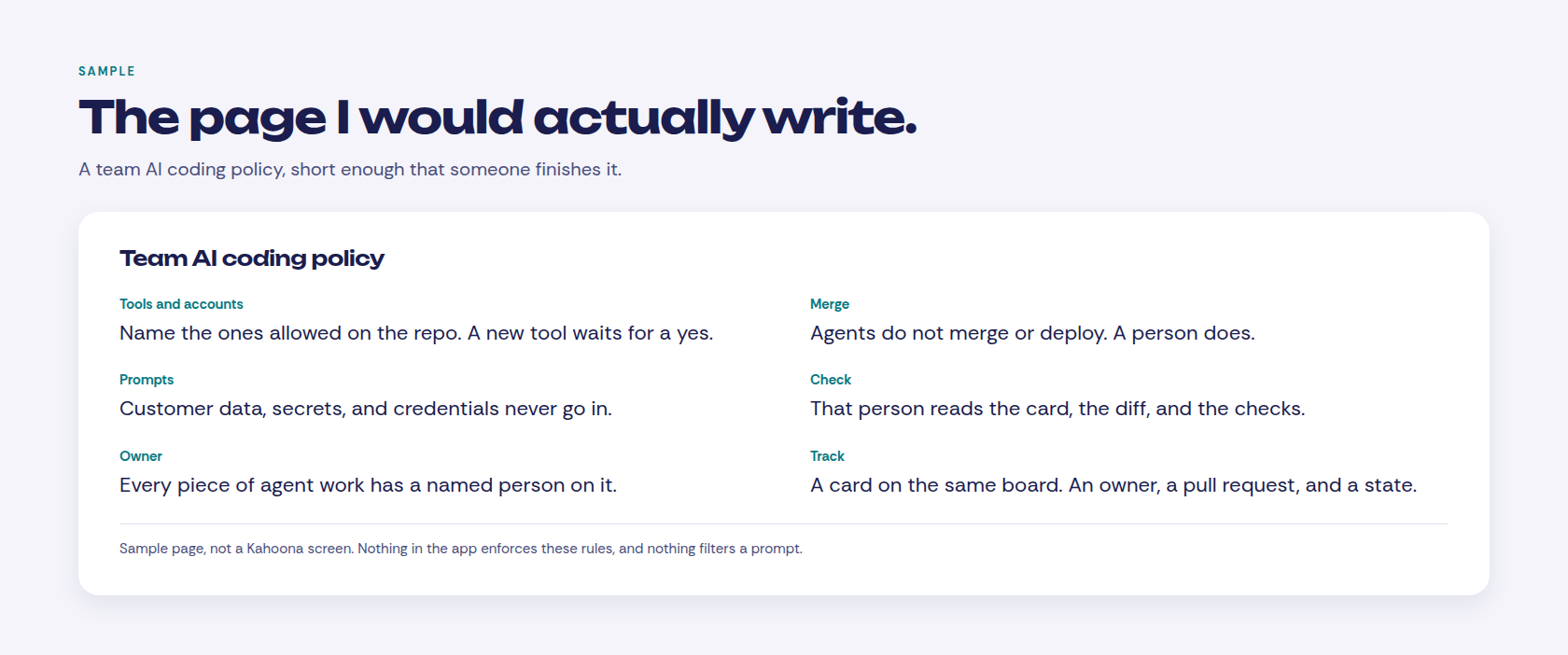
The page I would actually hand a team names the tools and the accounts allowed on the repo, and a new one waits for a yes. Customer data, secrets, and credentials never go into a prompt. Every piece of agent work has a named human owner before it starts. Agents do not merge, and they do not deploy. A person does. That person checks the card, the diff, and the checks, then merges. The work is a card on the same board as the human work, with that owner, a pull request, and a state you can see.
Who that person is, before the run starts, is in Name a human owner before the agents open pull requests. What they check before merge is one sentence here. The longer version is How to review AI agent pull requests without drowning. I am not repeating it.
The problem aint the missing PDF. The PDF cannot show you today's run. Kahoona will not enforce the page. It does not filter what someone pastes into Copilot, Cursor, or Claude Code on their own machine, and it does not keep a list of those accounts. If you want a tool that blocks a prompt or allow-lists the apps, this is the wrong one. Write the page anyway.
Put the last rule on the board
I noticed a weird thing during AI-driven development process: I am constantly putting extra pressure on AI agents by again and again asking for status updates - are we there yet? - and pushing for production readiness.
On one hand, this only amplifies the AI development psychosis, where I act like a traditional manager sending follow-ups, constantly asking if it is done yet.
On another, it feels like this pressure actually makes the work finish faster. Given how things are currently set up (and it's my harness's issue), I cannot just walk away and return to a well-organized result. The agents get stuck, they have extra questions, access issues, etc.
It still feels like I have to constantly micromanage the agent. It is amusing how the same psychological tactics used with humans apply here: if you constantly nag someone with status checks, they will likely finish faster just to make you stop.
I think this needs to be measured somehow, or perhaps models like Claude, which learned from humans, already operate on the same principle.
Stas Kulesh posted that on November 20.
I am constantly putting extra pressure on AI agents by again and again asking for status updates - are we there yet? - and pushing for production readiness.
The agents get stuck, they have extra questions, access issues, etc.
It still feels like I have to constantly micromanage the agent.
Given how things are currently set up (and it's my harness's issue), I cannot just walk away and return to a well-organized result.
He is blaming the harness. I am leaving it there. The status question is what you get when the run only lives in a terminal. A card that says Needs you, or Question for you, or that already has a pull request, is the state. You can stop asking that card.
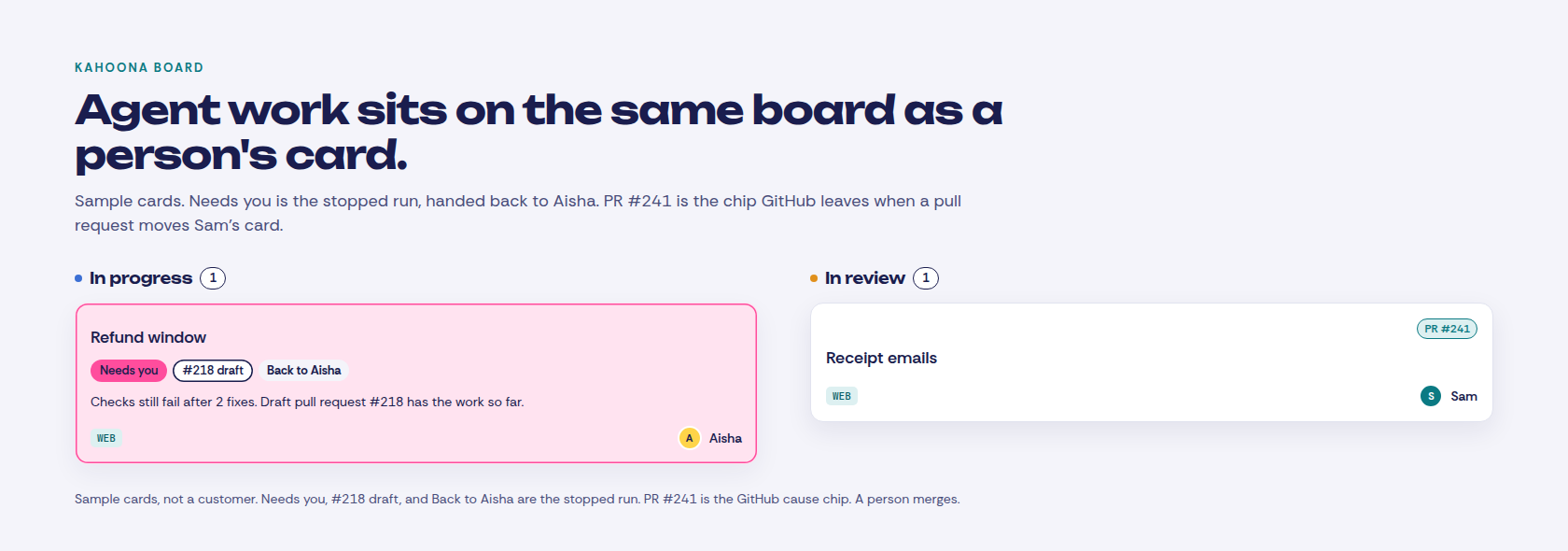
Reading shipped, on it, and stuck before anyone asks is Replace the daily standup with what shipped. One person and their own sessions is How to manage multiple Claude Code sessions without watching them. A team writes the page, and puts every agent card on the shared board. Connecting the agent to the ticket tracker is not the policy. Claude Code to Jira won't fix your process.
Claude Code, Cursor, Codex CLI, Claude Desktop, and VS Code can open the card over MCP. You create a token for that. The install is in Let Claude Code and Codex pick up tickets from your board with MCP.
A PR target will not turn review back on
At the start of the year our company set PR targets for everyone. Agents were mandatory, and the people who missed their numbers were "managed out". Most of them were the slow ones. The ones who actually read every PR and asked annoying questions.
Fast forward 10 months. We've had 3 security incidents since August, one of them made the news in our country. Now leadership sent an email asking everyone to "slow down and be more thorough with reviews".
Thorough with what. The people who knew how to do that are gone. The rest of us have spent a year being rewarded for speed, and most of the codebase was never really reviewed by anyone. You can't switch that back on with an email.
The mood on the team is the lowest I've seen it. Our best engineer handed in her notice last week. I'm honestly thinking about it too.
Is this happening at other companies, the full swing from "ship faster" to "why didn't anyone check this"? And did anyone actually recover from it?
u/FlatStill2540 posted that on November 20.
At the start of the year our company set PR targets for everyone. Agents were mandatory, and the people who missed their numbers were "managed out".
Now leadership sent an email asking everyone to "slow down and be more thorough with reviews".
You can't switch that back on with an email.
Yup. If the only rule was the count, an email will not grow the habit back. Counting pull requests once agents open them is Stop counting pull requests now that agents open them. I am not arguing it again.
Teams are mixed. On r/ClaudeCode, u/Sketaverse wrote that "quite literally the best 2 engineers I've worked with over the last 10 years - are both still writing all their code by hand." The page has to cover the person on Cursor and the person still typing.
What I run
I built Kahoona, so weigh this part.
You assign the card to Agent. That records who asked. The run comes back as a GitHub pull request on the repo linked to the project. Agents never merge, and they never deploy. When an assigned run stops, the card goes back to the person who assigned it, if they are still in the workspace and the card is still assigned to Agent. If they have left, the card is unassigned. A card someone already gave to another person is left alone. A mention leaves the card with whoever already owns it.
If the checks still fail after 2 fixes, the pull request stays a draft, the card says Needs you, and it sits in In progress. The line names the draft. A question during the run says Question for you. The agent is told to ask, then carry on with its best assumption and say which one it made. That question does not stop the run.
GitHub moves a card when a pull request names it and the sender is not a bot. A draft opening moves it to In progress. A pull request that opens ready for review, or a draft marked ready, moves it to In review. A merge with a closing word, on the branch the project watches, moves it to Done. Closing a pull request without merging only suggests a move back. The card shows the pull request number. You did not drag it.
The standup is the board. The Friday note is that project's GitHub activity for the week. Both are already written up in the standup post. I am not repeating them.
The MCP token is created by a person. It is stored on that user, for the workspace, as read-only or read and write. Revoke it and it stops working. The list shows the name you typed, a prefix, when it was created, and when it was last used. That is a list of tokens. It is not a list of Claude Code, Cursor, or Copilot accounts, and the name does not tell you which app is on the other end.
If the pull requests are already the board and you want that inside GitHub, stay there. Kahoona vs GitHub Projects.
Kahoona is free for one person. On a team the first chair stays free and each extra chair is $5 a month, so five people pay $20 and ten pay $45. It is a web app.
Write the page. Put the agent work on a card a person owns. A person merges.